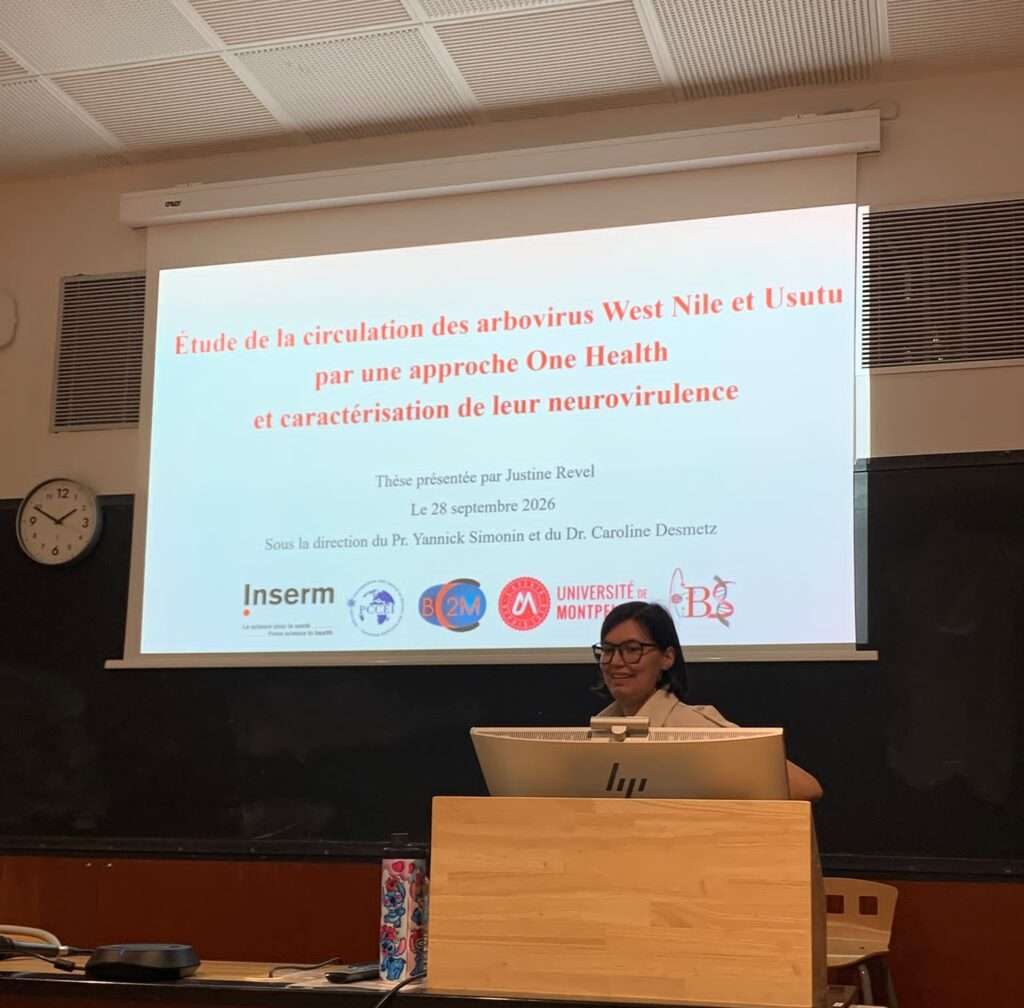
Justine Revel's Thesis Defense
Presented by Mohammed MIMOUNI
September 28, 2026
Supervised by Yannick SIMONIN (PCCEI) and Caroline DESMETZ
Study of the Circulation of West Nile and Usutu Arboviruses Using a One Health Approach and Characterization of Their Neurovirulence
Abstract:
The West Nile virus (WNV) and Usutu virus (USUV) are emerging arboviruses transmitted primarily by mosquitoes of the genus Culex, whose enzootic cycle involves birds as amplifying hosts. Their increasing circulation in Europe and their ability to cause neurological disorders make them a public health concern. This thesis aimed, on the one hand, to better characterize their circulation in southern France using a One Health approach and, on the other hand, to explore the mechanisms that may explain their differences in neurovirulence.
Avian surveillance conducted in Montpellier and the Camargue has revealed sustained circulation of WNV and USUV among resident and migratory birds, as well as dynamics that vary depending on the study areas and time periods. Longitudinal monitoring of captive birds has documented regular exposure to USUV and identified certain species as potential indicators of its local circulation. The detection of the virus in various avian, vector, and environmental matrices underscores their complementary nature and the value of multi-matrix surveillance that is not limited to a single compartment.
Despite their phylogenetic proximity, WNV and USUV differ markedly in the frequency and severity of the neurological forms associated with them. A comparative characterization of their NS1 proteins has revealed distinct properties, both in terms of their abundance and their effects on the blood-brain barrier. These differences provide new insights into the greater neurovirulence of WNV and support a role for NS1 in this phenotype.
Taken together, these studies show that a combined analysis of hosts, vectors, and the environment improves the detection and monitoring of WNV and USUV, while characterizing their viral determinants contributes to a better understanding of the consequences of their emergence.